

|NYPD Home | Contact | About Us |

 | Home | Mission | Exhibits | Events | Tour | Membership | Support | Info-FAQ's| Education|

Online Tour

    Museum Home

Frequently Asked Questions FAQ's

About The History Of The
New York City Police Department

Copyright 1999 ~ New York City Police Museum
No portion of this document may be copied, reproduced or otherwise used without the expressed written consent of the New York City Police Museum.

When Did Law Enforcement Begin in New York City? What Was the "Rattle Watch?"
When Did the New York City Police Department Actually Start? Where Did the Term "Cops" Come From?
Why Are There Green Lights Outside the Entrances of Police Precincts? When Did Police Officers Start Using Whistles?
Why Are "Night-sticks" Called by That Name? What Is the Meaning of the Police Flag?
What Do the Symbols on the Police Department Shoulder Patch and Police Officer's Shield Mean? Spring 3100 is the name of the official NYPD Magazine.  What Does that Name Mean?
The NYPD's Official Motto is "Fidelis Ad Mortem."  What Does it Mean? When Was the First Patrol Guide Issued?
When Did African-Americans First Enter the NYPD? When Were the First Hispanic Police Officers Appointed?
When Did the First Women Enter the NYPD? How Many Police Officers Have Been Killed in the Line-of-Duty?
How Many Police Commissioners Have There Been? When Were Detectives First Appointed by the NYPD?
When Did the NYPD Wear Those "Keystone Cops" Type Helmets? Why Does a Police Officer's Hat Have 8 Points on the Top?
When Did Police Officers Begin to Carry Guns? When Did the NYPD Start Using Bicycles for Patrol?
When Did the NYPD Begin to Use Motorcycles? When Did the NYPD First Begin Using RMPs (Radio Motor Patrol Cars)?
When Did the NYPD Begin to Use Fingerprinting? When Were the "Transit" and "Housing" Police Departments Created?

WHEN DID LAW ENFORCEMENT BEGIN IN NEW YORK CITY?

The first law-enforcement officer began to patrol the trails and paths of New York City when it was known as New Amsterdam, and was a Dutch settlement and fort in the year 1625. This lawman was known as a "Schout – fiscal" (sheriff – attorney) and was charged with keeping the peace, settling minor disputes, and warning colonists if fires broke out at night. The first Schout was a man named Johann Lampo.

Return to the top


WHAT WAS THE RATTLE WATCH?
The Rattle Watch was a group of colonists during the Dutch era (1609 - 1664) who patrolled from sunset until dawn. They carried weapons, lanterns and wooden rattles (that are similar to the ratchet noisemakers used during New Year celebrations). The rattles made a very loud, distinctive sound and were used to warn farmers and colonists of threatening situations. Upon hearing this sound, the colonists would rally to defend themselves or form bucket-brigades to put out fires. The rattles were used because whistles had not yet been invented. The Rattle Watchmen also are believed to have carried lanterns that had green glass inserts. This was to help identify them while they were on patrol at night (as there were no streetlights at that time). When they returned to their Watch House from patrol, they hung their lantern on a hook by the front door to show that the Watchman was present in the Watch House. Today, green lights are still hung outside the entrances of Police Precincts as a symbol that the "Watch" is present and vigilant.
Return to the top


WHEN DID THE NEW YORK CITY POLICE DEPARTMENT ACTUALLY START?
When the High Constable of New York City, Jacob Hays retired from service in 1844, permission was granted by the Governor of the state to the Mayor of the City to create a Police Department. A force of approximately 800 men under the first Chief of Police, George W. Matsell, began to patrol the City in July of 1845. They wore badges that had an eight-pointed star (representing the first 8 paid members of the old Watch during Dutch times). The badges had the seal of the City in their center and were made of stamped copper.

Return to the top


WHERE DID THE TERM "COPS" COME FROM?
When the first police force began to patrol in the summer of 1845, they only badges on their civilian clothing. The badges were 8 pointed stars with the seal of the City at the center and were made of stamped copper. The newspapers of the time referred to the new force as the "Star Police" but people seeing the shiny copper shields began to call the new force "Coppers" which was later shortened to "Cops."
There is also a British police term; Constable On Patrol which may account for the term "cops" in England as well.


Return to the top


WHY ARE THERE GREEN LIGHTS OUTSIDE THE ENTRANCES OF POLICE PRECINCT BUILDINGS?
It is believed that the Rattle Watchmen, who patrolled New Amsterdam in the 1650's, carried lanterns at night with green glass sides in them as a means of identification. When the Watchmen returned to the watch house after patrol, they hung their lantern on a hook by the front door to show people seeking the watchman that he was in the watch house.  Today, green lights are hung outside the entrances of Police Precincts as a symbol that the "Watch" is present and vigilant.

Return to the top


WHEN DID POLICE OFFICERS START USING WHISTLES?
Whistles began to be used because police officers needed a way to signal other officers on near-by posts. Carved wooden whistles were used as early as 1854, and by 1860, the "pea" whistle (a cast lead casing with a small dried pea inside to give a "warble" sound) was in use. Up until that time, signaling was done by hitting a curbstone, wall or ash can lid with the nightstick, or even firing off a pistol shot. Around 1889, the tubular whistle used by the British "Bobbies" came into use by the N.Y.P.D. because it was very loud and had a distinctive sound. The tubular whistle was retired from Department use in 1959 because improved electronic communications available to police officers made it unnecessary. However, the "traffic" whistle was retained in service and is the one and only whistle used by the N.Y.P.D. today.

Return to the top


WHY ARE "NIGHT-STICKS" CALLED BY THAT NAME?
Police Officers used to carry two kinds of sticks or batons. The first was called a day-stick and was approximately 11 inches long.  The second was called a night-stick and was approximately 26 inches long. Both sticks were made of wood, typically oak or mahogany, and had a leather thong or lanyard through the handle so that it could be carried or hung from the officer's hand while on patrol. The night-stick was longer because it afforded extra protection when carried by officers at night. Today, the night stick is carried by officers on all tours.

Return to the top


WHAT IS THE MEANING OF THE POLICE FLAG?
The Police flag that flies outside Precincts and other Police Department buildings was first created in 1919. It bears five alternating green and white bars, representing the five boroughs of New York City; Manhattan, Brooklyn, Queens, Staten Island and the Bronx. There are 24 white stars on a field of blue in the left corner of the flag. The blue field represents the Police Department. Twenty-three of the stars represent the separate towns and villages that became part of New York City under the Consolidation that took place in 1899. The 24th star represents the City itself. Of those towns and villages that became part of New York City in 1899 (creating "Greater New York"), 18 had separate police departments that became part of the N.Y.P.D.

Return to the top


WHAT DO THE SYMBOLS ON THE POLICE DEPARTMENT SHOULDER PATCH AND POLICE OFFICER'S SHIELD MEAN?
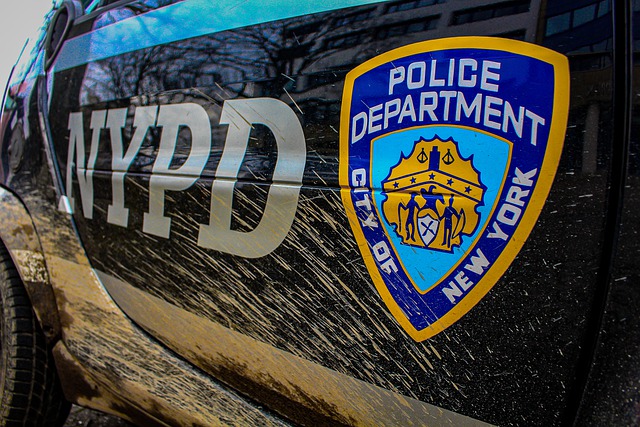
The N.Y.P.D. patch was adopted on July 1, 1971. Both the patch and Police Officer's shield are modeled after the seal of New York City. In the center of the patch are the scales of justice balanced on a bundle of rods or sticks with an ax-blade at the top, all of which are tied together. This bundle is called a "fasces" and was carried by ancient Roman magistrates as a symbol of their official powers. Beneath this symbol is an inverted "V," or chevron, that has five stars representing the five boroughs of the City. Beneath the chevron appears the seal of the Police Department.
The Department seal appears on both the shoulder patch and the police officer's shield. Two figures appear on the left and right of the center. On the left side is the image of a British sailor (representing the English influence on New York's history). The sailor is holding a "sounding-lead" on a rope. This device was used to test the depth of the river while navigating ships. The figure on the right of the center of the shield is a native-American, holding a bow. This figure represents the natives that lived in the New York area when the Dutch colonists first arrived in the 16th century. In the center of the seal is a shield-shape with the crossed arms of a windmill on it that represents the Dutch heritage of the City. Between the crossed arms of the windmill appear two beavers and two barrels. These represent the native animals and plant products (like corn and tobacco) of the region that supported the new colonists. Above the central shield-shape appears an eagle, representing the federal government of America established with the declaration of Independence in 1776. The Eagle rests upon a hemisphere that represents the "New World."

Return to the top


SPRING 3100 IS THE NAME OF THE N.Y.P.D.'S MAGAZINE.
WHAT DOES THE NAME MEAN?
When the N.Y.P.D. decided to create and publish a magazine in 1930, they held a competition to name it. The winning entry was the telephone exchange number for the old Police Headquarters building on Centre Street. This number has become a symbol not only of the magazine but also of the N.Y.P.D. As such, it is sometimes used when a photograph of a shield, squad car or other piece of equipment is shown in Department publications.

Return to the top


THE N.Y.P.D. OFFICIAL MOTTO IS "FIDELIS AD MORTEM."
WHAT DOES IT MEAN?
The N.Y.P.D. official motto (translated from Latin) is "Faithful Unto Death." The motto first appeared on the Flag of Honor that was presented to the N.Y.P.D. by the grateful citizens of New York City in 1872 for preserving the peace of the City and suppressing the Civil War draft riots in 1863, as well as the religious/political Orange Riot in 1871.

Return to the top


WHEN WAS THE FIRST PATROL GUIDE ISSUED?
When the N.Y.P.D. was officially created in July of 1845, the first Chief, George W. Matsell, wrote and published a guide for the new force entitled, "Rules and Regulations of the Day and Night Police of the City of New York with Instructions as to the Legal Powers and Duties of Policemen." This small 75 page book that policemen kept in their back pocket listed numerous laws and ordinances and described how to protect life and property in various situations. The Regulations also instructed policemen to suppress crime before it occurred by being vigilant at all times. This was the first publication of its kind and evolved to its present form.

Return to the top


WHEN DID AFRICAN-AMERICANS FIRST ENTER THE N.Y.P.D.?
In 1891, the City of Brooklyn Police appointed Wiley G. Overton as the first pre-consolidation African-American policeman.
In 1911, the N.Y.P.D. appointed Samuel J. Battle as the first African-American policeman.
In 1920, the N.Y.P.D. appointed Lawon R. Bruce as the first African-American policewoman.

Return to the top


WHEN DID THE N.Y.P.D. FIRST APPOINT HISPANIC POLICE OFFICERS?
In 1896, George Garcia was appointed as the first Hispanic police officer.

Return to the top


WHEN DID THE FIRST WOMEN ENTER THE N.Y.P.D.?
On October 6, 1891, in response to requests from reform groups to have personnel to transport and search female arrestees and prisoners, the N.Y.P.D. appointed the first four Police Matrons. In 1918, the title of Policewoman was created and the first six officers were appointed.

Return to the top


HOW MANY POLICE OFFICERS HAVE BEEN KILLED IN THE LINE-OF-DUTY?
The first recorded police officer's death in the line-of-duty was in 1854. Currently, over 600 police officers have been killed in the line-of-duty.

Return to the top


HOW MANY POLICE COMMISSIONERS HAVE THERE BEEN?
In 1901, a single Police Commissioner began to be appointed. Prior to that time, a board of up to four Commissioners were appointed to oversee Department operations. Police Commissioner Raymond J. Kelly is the 41th Police Commissioner of the City of New York.

Return to the top


WHEN WERE DETECTIVES FIRST APPOINTED BY THE N.Y.P.D.?
In 1882, the Detective Bureau was formally created. Prior to that time, the Department used undercover officers, dressed in civilian clothes called "shadows" to infiltrate crowds at parades and public events and arrest pickpockets and cutpurses.

Return to the top


WHEN DID THE N.Y.P.D. WEAR THOSE "KEYSTONE COPS" TYPE HELMETS?
The helmets, gray for the summer and blue for winter use, were in use from approximately 1880 to 1912. They were replaced by a round cap that was less likely to be lost when riding in an open truck or car, or on a bicycle.

Return to the top


WHY DOES A POLICE OFFICER'S HAT HAVE 8 POINTS ON THE TOP?
The N.Y.P.D. eight-point hat, which has been in use since 1928, is symbolic of the eight original members of the first Watch, in Dutch colonial New Amsterdam.

Return to the top


WHEN DID POLICE OFFICERS BEGIN TO CARRY GUNS?
Police Officers have been officially carrying firearms while on duty since 1887, Rule 503 of the "Manual of Rules and Regulations" stated: "In addition to the ordinary baton of the patrolman each member of the Police Force shall be armed while on duty with a revolving pistol of pattern and caliber approved by the board."

In 1895 a school of Police Pistol Practice opened. Pistol practice officially started on December 30, 1895.

On June 3, 1896 the Police Board resolved to adopt a standard revolver. A .32 caliber double action 4 inch barrel Colt revolver became the standard weapon.

In 1901 the department rule changed to "each, member of the patrol force shall be armed on duty with a revolving pistol of .38 caliber…stamped with a number corresponding to the shield number of the officer." Officers of the force were exempt from the new rule and allowed to continue carrying their .32 caliber revolver.

The service revolver remained the primary weapon of Police Officers until 1993 when the Department started to equip new officers with 9mm semi-automatic pistols. The 9mm is the current service weapon of NYC Police Officers with most officers having transferred over from the old .38 caliber revolvers.

Return to the top


WHEN DID THE N.Y.P.D. START USING BICYCLES FOR PATROL?
In 1895, the N.Y.P.D. Bicycle Squad was formed. Consisting of 29 men on high speed bikes, the "Scorcher" Squad (known for their smoking wheels) made over 1300 arrests in their first year of operation.

Return to the top


WHEN DID THE N.Y.P.D. BEGIN TO USE MOTORCYCLES?
In 1911, the N.Y.P.D. created the Motorcycle Squad. By 1912, the Department had 25 "Indian" motorcycles in use in the City to deal with traffic problems.

Return to the top


WHEN DID THE N.Y.P.D. FIRST BEGIN USING RMP'S (RADIO MOTOR PATROL CARS)?
The first patrol car was used in 1917. Later when radios were installed, the radio inside the vehicle could only receive messages. This required the officers to pull over to a call box and acknowledge the messages when received. In 1937, technology had improved and two-way radiotelephones were installed in RMPs. It wasn't until 1950 that all police cars had two-way radios.

Return to the top


WHEN DID THE N.Y.P.D. BEGIN TO USE FINGERPRINTING?
In 1906, N.Y.P.D. Police Commissioner McAdoo sent Det. Sgt. Joseph Faurot to London to obtain information of the process of fingerprinting, where it had been in use for several years.  Det. Sgt. Faurot returned with samples of the first fingerprint cards, at which time the Department began to implement this new crime fighting technique.  In 1908, a murder case was the first case solved by the N.Y.P.D. utilizing this technology.

Return to the top


WHEN WERE THE "TRANSIT" AND "HOUSING" POLICE DEPARTMENTS CREATED?
The N.Y.C. Housing Authority was created in 1934. At that time, the Housing Authority hired security guards to patrol the developments. These guards were later specially trained and became the first officers when the Housing Authority Police was officially created in 1952.
In 1936, Mayor LaGuardia created the post of "Special Patrolman" on the subway system.  The Transit Authority Police Department was officially created in 1953.
Both the Transit and Housing Police Departments were subsequently merged with the N.Y.P.D. in 1995, and are now known as the Transit Division and Housing Bureau.

Return to the top


Additional NYPD History Sources


< Home | Downtown Links | Contact >